Power is a strong charactristic. It can determine the amount of importance one has, and it can determine whether or not a person has a voice among others, along with many other things. In today’s society, power differs between people based off their race, the religion they follow, their gender, etc. It is the same way in The Handmaid’s Tale; the amount of power a person in the novel has differs based on their age, their gender, the amount of money they have, and their fertility. In the novel, The Handmaid’s Tale, Margret Atwood displays the theme of power numerous times throughout the book that also connects with today’s real world in several different ways.
In The Handmaid’s Tale, Atwood displays the theme of power on page 182. It says, “But something had shifted, some balance. I felt shrunken, so that when he put his arms around me, gathering me up, I was as small as a doll.” This clearly shows the theme of power because Offred is describing how she felt in Luke’s arms after her power was taken away. Although the only power that was taken from her along with all other women was her ability to make and spend her own money, she still felt as if Luke had more power over her because he could do something more that she couldn’t. The truth is, Luke and every other man did gain more power over her because of this. Also on page 182 it says, “We are not each other’s anymore. Instead, I am his.” This piece of text greatly exhibits the theme of power because it shows that Offred has no power anymore, for it has been diminished by the fact that she lost her job and her money was cut off. Now, instead of having power and being able to be an independent woman, she is forced to rely on Luke. This easily makes her feel as if she is his because she now cannot do much anything with out his help. This connects to the real world because it relates to the fact that often times, the power that women hold in today’s world is overtaken by the power that most men have. In an article from politico.com, Keisha N. Blain answers, “Regardless of a women’s experience, education or abilities, the patriarchal nature of U.S. society fosters the oerception that women are less qualified and less competent than men. What patriarchy has done is convince people that a strong and intelligent woman represents a problem.” This quote explains that a strong woman is a bad thing, which is how the men in The Handmaid’s Tale saw women even before the dystopia, Gilead, was created. Because of this, the independent and strong women’s power is lessened by the more power men have.
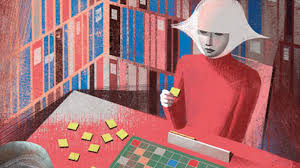
Another instance where Atwood shows the theme of power in her novel is on page 210 when she wrote. A quote on page 210 displays the theme of power is “Right now I’m not afraid of him. It’s hard to be afraid of a man who is sitting watching you put on hand lotion. This lack of fear is dangerous.” This theme also shows how Offred is gaining power over the Commander. It is easy to see that in this piece of text because Offred is losing her fear of the Commander which, in turn, gives her power. On page 186 it says, “The pen between my fingers is sensuous, alive almost. I can feel its power, the power of the words it contains.” This quote shows the power Offred feels just by doing something as simple as writing. Since Gilead was created, she hadn’t been allowed to read or write, so the fact that she was able to do this when all other women couldn’t, makes her feel power over those women and the Commander because she was able to write in his presence. These pieces of text relate to the real world because they model how people with little power can use people of high power to gain theirs. When talking about power in an article from wordpress.com, an author writes, “Influential Power- Is when the person does not have power and they are trying to gain influence over you.” It also says, “Instrumental Power- When the person already has power over usually due to authority or law.” These types of power are both seen by the relationship between Offred and the Commander. Influential power is used by Offred because she used the advantage of their “meetings” to get things such as hand lotion and the ability to read and write while playing their Scrabble games. The Commander uses the instrumental power he has over Offred and most other people because he is one of the creators of Gilead which makes him very high up in authority.
One more example of the theme of power in The Handmaid’s Tale is on page 210 when it says, “It’s difficult for me to believe I have power over him, of any sort, but I do; although it’s of an equivocal kind.” This quote shows that even though it’s a minute amount, Offred has gained power over the Commander. She recognizes that it’s not the same amount that he has over her, but she notices that she has the power, which is important to her. Throughout the novel during their meetings, Offred uses this small amount of power to take tiny advantages over the Commander. On forbes.com, Janet Napolitano states, “I think power is the ability to affect change and to not necessarily control but to manage issues and mange people to achieve a larger vision.” This relates to the quote from The Handmaid’s Tale because Offred uses the power she gains over the Commander to take the advantages over him throughout the novel. She affects change in her life by using her power that not many other women have to get some of the things she wants that the Commander can get for her.
In The Handmaid’s Tale, Margret Atwood incorporates the theme of power numerous times. She uses this theme so she can show how the importance of the people in Gilead differ based on the amount of power they hold. To Offred, power comes to her in different ways that can be clearly seen by the reader throughout the novel. In this novel, Atwood displays the theme of power throughout her book, which also connects to today’s real world.
 And That's the Tea, Sis