Relationships On (the) Line
Over time, social media has changed the way we connect with people. From Match.com to MySpace to Snapchat, relationships are affected by social media everyday. Social media can be beneficial, especially with the fact that it helps connect people over long distances, but it also can weaken real life relationships and make the relationships between people less authentic.
Social media allows relationships to be held over long distances. Dating apps are a increasingly popular way for men and women to meet, create relationships, and even find love between each other. Without the use of social media to connect them, many of these people would’ve never met and found love. According to datingadvice.com, “About 17% of marriages and 20% of relationships begin online.” Although 17% and 20% seem like small amounts, that is a fifth of people in this world who have been able to create relationship with each other. Social media also can help maintain long distance friendships, relationships, family connections, etc. by keeping people in contact while far away. An article from psychcentral.com says, “Internet has offered many a convenient way to locate, reconnect, and rekindle relationships that otherwise would have been lost.” So, by using social media, families, friends, and spouses are able to stay in touch and keep up with their relationships even miles and miles apart.

Although social media allows relationships over long distances to thrive, it can also cause peoples’ face-to-face relationships to weaken. In another section from the article from by Shelley Galasso Bonanno, it argues, “Individuals might forego real-life interactions in order to maintain online communication.” So, instead of focusing on relationships in person, people become consumed with their online relationships. In turn, this results in the lack of social skills presented by people along with the loss of some face-to-face relationships. While this is true, others may argue that if the real-life relationship was important to a person then they would make sure that the relationship was held, however, if it’s not as important as their online relationships then they won’t be as concerned in keeping up with the real-life relationship.
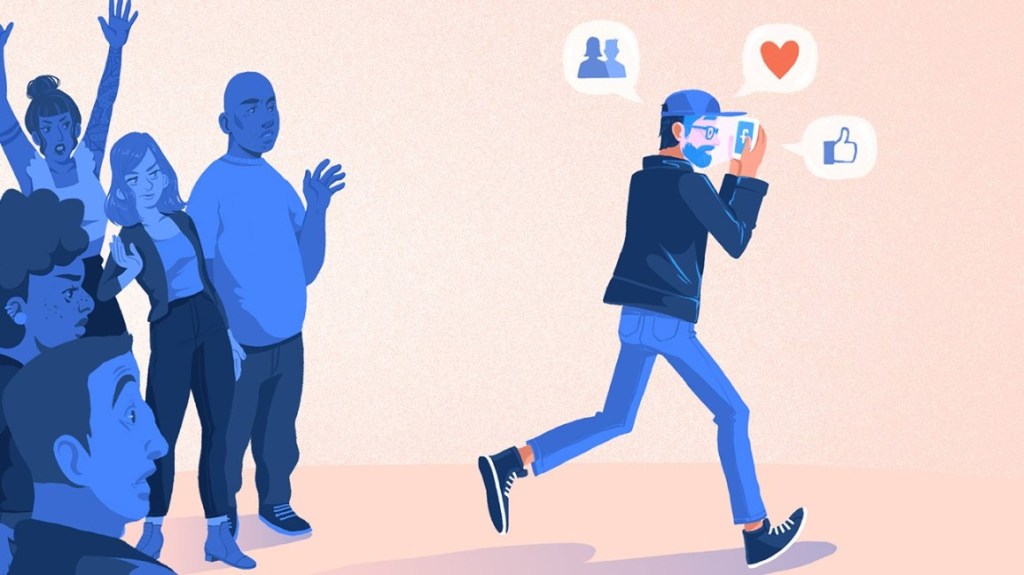
With relationships heavily influenced by social media, the thought that the connections made in person aren’t as authentic comes. In a TedTalk by Mayurakshi Ghosal she says that social media apps such as Snapchat build superficial relationships instead of real ones. Most people use social media as verification for their friendships and Ghosal further explained this when she stated that the “streaks” between her friends that she kept up with on Snapchat were proof of their friendship. So, even if her and her friend talked in person daily, their friendship wasn’t real until they kept a “streak” on an app. She felt that even though she was with her friend often, she didn’t actually know her because their friendship was only real in the world of social media. Also, in an article by Olivia Desilts from odyssey.com, she says, ” People get carried away and demand to be seen on someone else’s social media.” This is one other way that displays how social media had created a need for posts, likes, views, or streaks to “verify” personal connections with each other.

With this thought, some may argue that while some friendships are made for the views or the likes and aren’t completely real, but some of these fake relationships formed for social media could result in real friendships or relationships, even though it was not intended in the first place. From personal experience and seeing some of the friendships made among my peers, I have seen fake friendships form for more popularity or attention, but some of these friendships did turn out to be true in the end. Not all relationships that are affected heavily by social media are fake, but most of them do need verification from others to prove their friendship or deep connection.
Online relationships aren’t as deep or personal as real-life relationships. The article by Shelley Galasso Bonanno says, “It is often difficult, if not impossible, on social media to reveal qualities that define deep, intimate relationships.” This helps to explain that qualities found in real-life relationships such as body language, tone of voice, gestures, etc. can not be reciprocated through social media. This makes it very hard to show the same signs through social media as well as in real life.
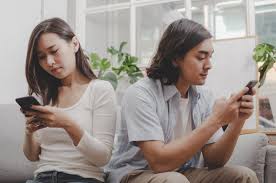
Online relationships can be beneficial in some ways. If the people are over long distances or aren’t as comfortable in social situations, social media is resourceful, however, it doesn’t give as deep of a connection as face-to-face relationships. In the same article as before, Bonanno says, “Online friendships, while certainly valuable in many ways, lack the ability to provide us with opportunities for deep and lasting emotional closeness.” She explains that while beneficial in some ways, social media has an absence of the connections that could be made in real life. Some might say that the relationships made online could be the equivalent of those made in real life, but most people with this thought might not have had as deep as connections in real life as others.
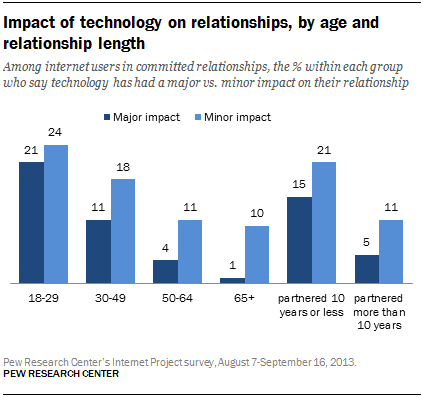
Social media has a larger affect on younger and newer relationships than it does on older and more aged relationships. In a graph from pewresearch.com, it’s main claim states, “Social media had less affect on people’s relationships as the get older and as their relationships go on.” This claim is supported by that data taken in 2013. The graph shows that from ages 18 to 29, 21% of relationships are majorly affected by social media. From ages 50 to 60, however, only about 4% of relationships become majorly affected by social media’s influences. Also, 15% of partners for ten years or less are affected majorly by social media, while only 5% of partners for ten years or more are majorly affected by social media. This goes to prove the point that newer generations and newer couples are more affected by social media and this could be the cause of more relationships not working out or not being as deeply connected as those of couples who have been together longer or people of an older age.
The frequent amount of relationships made on social media daily can certainly be seen as be beneficial, however, social media does have a heavy impact on them especially seen in younger ages. Social media is able to connect people of long distances in order to maintain long distance relationships, but it also may create relationships that aren’t as authentic or make real life relationships weak.
About Haley Fowler
Haley Fowler is a tenth grade student in Kentucky. She is a proficient and avid user of social media and many ideas and events in her life are influenced positively and negatively by social media.
 And That's the Tea, Sis