Be yourself; Everyone else is already taken.
— Oscar Wilde.
This is the first post on my new blog. I’m just getting this new blog going, so stay tuned for more. Subscribe below to get notified when I post new updates.
Be yourself; Everyone else is already taken.
— Oscar Wilde.
This is the first post on my new blog. I’m just getting this new blog going, so stay tuned for more. Subscribe below to get notified when I post new updates.
As I listened to this podcast, every episode leas me to new ideas about who could be innocent/guilty and why. I had a hard time coming to a final decision on who murdered Hae Min Lee, and I’m still unsure on a final person. There were so many pieces of evidence left unstudied; for example, no DNA was taken and tested from Hae’s body, many people who testified changed their stories often or their stories didn’t match up with the timeline one that detectives had, etc. With this being said, I don’t think Adnan Syed committed the murder, and even if he did do it, more people were involved than just him and Jay. There are numerous amounts of theories that can be drawn from this case.
After listening to all of the evidence stated on the podcast, I lean more towards Adnan being innocent. Rabia Chaudry said, “He was like the community’s golden child.” According to people that knew him, Adnan was a good kid and was never into any trouble. There was one point in the podcast when Adnan said “It’s a very shameful thing that I did. I’ve never denied it.” He was admitting to stealing donation money from his mosk, but that was the only bad thing people could remember him doing. Why would someone who was never into any trouble with the law suddenly wants to murder his ex girlfriend with his bare hands. I get that he might’ve been upset after him and Hae broke up, but I don’t think that a boy who had never really been in trouble would kill someone. I definitely think Jay was involved with the murder no matter who the killer was. The fact that he was able to take police to Hae’s car and he had such a detailed story about the day of the murder can easily show that Jay was involved. A detective said, “Before you stated you’d be willing to take us out and show us where the vehicle’s parked.” Jay answered back, “No problem.”
The parts of this case that leave me unsure of Adnan being innocent is his cell phone record as well as many people as many people seeing Jay and Adnan together at various times on January 13, 1999. For instance, when the boys randomly popped up at Cathy’s house and they both weren’t very close with her. “–and I was kinda surprised and a little confused because he didn’t call me unless he was with Jenn and nobody had called to say ‘hey are you guys home? Do you guys want to hangout?’ Nothing like that. So it was a little strange that he would just pop up at the door.” It was mentioned several times throughout the podcast the Adnan’s cell phone was pinged cell towers in areas where Jay said he was and helped complete his story. Also his cell phone record was taken as one of the biggest pieces of evidence. “The one where Adnan calls his own phone and says, ‘come and get me. I’m at Best Buy.’ you can see it on the call log.”
The 1920s was a time of growing wealth and extravagant lives for the people who had money. Grand parties and other events were often held to flaunt money. In Fitzgerald’s “The Great Gatsby”, he uses various characters and events in order to show the difference in power that wealth brings. Throughout the novel, Fitzgerald uses money and characters’ class to determine the amount of power they hold in society.
Jay Gatsby showed his wealth off to gain power. According to NCpedia.org, “The 1920s represented an era of change and growth. The decade was one of learning and exploration.” In the 1920s, people were finally able to spend their money on entertainment an things that they wanted, rather than only spending their money on necessities. In “The Great Gatsby”, Gatsby spent his money on extravagant parties almost every week. These large parties flaunted his wealth, which gave him power. On page 39 it says, “There was music from my neighbor’s house through the summer nights. In, his blue gardens men and girls came and went like moths among the whisperings and the champagne and the stars.” This was Nick’s first glance at one of Gatsby’s parties. Gatsby showed his wealth off in order to gain Daisy’s attention. It was clear to see the Daisy was attracted to money and the status it could give her, so once Gatsby gained all of his new money, she noticed him again and wanted to be with him now, instead of Tom. When they had met before, Gatsby didn’t have enough money for Daisy to be able to stay with him, and then she found and married Tom. Once Gatsby gained all of his money, he built a grand house, and was able to buy Daisy’s attention and rekindled love. On page 75 it says, “The officer looked at Daisy while she was speaking, in a way that every young girl wants to be looked at some time.” This quote shows that Gatsby’s love for Daisy was real, when at first her love was real, but eventually she cared more about money than real love.
Seeing as Daisy used Tom for his money and status, and then Gatsby for his, it can also be concluded that Daisy Buchanan views wealth and status as power. When she was young, Daisy fell in love with Jay Gatsby, but since they were so young and Gatsby was unwealthy, her parents did not allow it. This may have put the idea that wealth equals status and power in her head. This was one of the reasons Daisy fell in love with her husband Tom. He had a high status and was very rich, which grabbed Daisy’s attention and led her to marry him. Even though Tom treats her poorly and she knows about his affair, she doesn’t try to end the marriage because of all of the status and wealth she gains from Tom. On page 130 it says, “‘She never loved you, do you hear?’ he cried. ‘She only married you because I was poor and she as tired of waiting for me. It was a terrible mistake, but in her heart she never loved any one except me!'” This shows that Daisy was tired of waiting on Gatsby to get out of the war and become rich, so she found the wealthy Tom Buchanan and married him for his money and not because she loved him. This also explains why Daisy was so interested in Gatsby after he gained all of his new money. Not only was she in love with him before he was rich, Gatsby also gained a large amount of money which Daisy loved as well. On page 120 it says, “‘Her voice is full of money,’ he said suddenly. That was it. I’d never understood before. It was full of money — that was the inexhaustible charm that rose and fell in it, the jingle of it, the cymbals’ song of it… High in a white palace the king’s daughter, the golden girl…” This quote shows that Daisy is a gold digger and only cares about money, as stated before.
Myrtle Wilson is also a character who sees wealth and status gives power. That is the only reason she wanted to have an affair with Tom Buchanan. She thought that if she could get away from her poor husband and have the affair with Tom, she would gain a higher status in society. On page 34 it says “‘I married him because I thought he was a gentleman,’ she said finally. ‘I thought he knew something about breeding, but he wasn’t fit to lick my shoe.'” This quote reveals that Myrtle thinks that marrying her husband, George Wilson, was a mistake. It also shows that the reason their marriage is a mistake is because he isn’t good enough for her and isn’t up to her standards. She did, however, think Tom was up to her standards which is why she began the affair because Tom is rich enough for unlike George. On page 27 it says, “Up-stairs, in the solemn echoing drive she let four taxicabs drive away before she selected a new one, lavender-colored with gray upholstery…” This quote shows how materialistic Myrtle is. She only wanted the fancy taxicab, rather than the plain regular one. Myrtle is so desperate to have a high status in society the she cheated on her husband and went out of her way to make sure she had things that was different from everyone else.
In all, characters in F. Scott Fitzgerald’s “The Great Gatsby” see wealth and high status as power. The more money one has, the more they are valued in society. He develops the characters in a way that readers can see which characters value wealth more. Throughout the novel, Fitzgerald uses money and characters’ class to determine the amount of power they hold in society.
Over time, social media has changed the way we connect with people. From Match.com to MySpace to Snapchat, relationships are affected by social media everyday. Social media can be beneficial, especially with the fact that it helps connect people over long distances, but it also can weaken real life relationships and make the relationships between people less authentic.
Social media allows relationships to be held over long distances. Dating apps are a increasingly popular way for men and women to meet, create relationships, and even find love between each other. Without the use of social media to connect them, many of these people would’ve never met and found love. According to datingadvice.com, “About 17% of marriages and 20% of relationships begin online.” Although 17% and 20% seem like small amounts, that is a fifth of people in this world who have been able to create relationship with each other. Social media also can help maintain long distance friendships, relationships, family connections, etc. by keeping people in contact while far away. An article from psychcentral.com says, “Internet has offered many a convenient way to locate, reconnect, and rekindle relationships that otherwise would have been lost.” So, by using social media, families, friends, and spouses are able to stay in touch and keep up with their relationships even miles and miles apart.

Although social media allows relationships over long distances to thrive, it can also cause peoples’ face-to-face relationships to weaken. In another section from the article from by Shelley Galasso Bonanno, it argues, “Individuals might forego real-life interactions in order to maintain online communication.” So, instead of focusing on relationships in person, people become consumed with their online relationships. In turn, this results in the lack of social skills presented by people along with the loss of some face-to-face relationships. While this is true, others may argue that if the real-life relationship was important to a person then they would make sure that the relationship was held, however, if it’s not as important as their online relationships then they won’t be as concerned in keeping up with the real-life relationship.

With relationships heavily influenced by social media, the thought that the connections made in person aren’t as authentic comes. In a TedTalk by Mayurakshi Ghosal she says that social media apps such as Snapchat build superficial relationships instead of real ones. Most people use social media as verification for their friendships and Ghosal further explained this when she stated that the “streaks” between her friends that she kept up with on Snapchat were proof of their friendship. So, even if her and her friend talked in person daily, their friendship wasn’t real until they kept a “streak” on an app. She felt that even though she was with her friend often, she didn’t actually know her because their friendship was only real in the world of social media. Also, in an article by Olivia Desilts from odyssey.com, she says, ” People get carried away and demand to be seen on someone else’s social media.” This is one other way that displays how social media had created a need for posts, likes, views, or streaks to “verify” personal connections with each other.

With this thought, some may argue that while some friendships are made for the views or the likes and aren’t completely real, but some of these fake relationships formed for social media could result in real friendships or relationships, even though it was not intended in the first place. From personal experience and seeing some of the friendships made among my peers, I have seen fake friendships form for more popularity or attention, but some of these friendships did turn out to be true in the end. Not all relationships that are affected heavily by social media are fake, but most of them do need verification from others to prove their friendship or deep connection.
Online relationships aren’t as deep or personal as real-life relationships. The article by Shelley Galasso Bonanno says, “It is often difficult, if not impossible, on social media to reveal qualities that define deep, intimate relationships.” This helps to explain that qualities found in real-life relationships such as body language, tone of voice, gestures, etc. can not be reciprocated through social media. This makes it very hard to show the same signs through social media as well as in real life.

Online relationships can be beneficial in some ways. If the people are over long distances or aren’t as comfortable in social situations, social media is resourceful, however, it doesn’t give as deep of a connection as face-to-face relationships. In the same article as before, Bonanno says, “Online friendships, while certainly valuable in many ways, lack the ability to provide us with opportunities for deep and lasting emotional closeness.” She explains that while beneficial in some ways, social media has an absence of the connections that could be made in real life. Some might say that the relationships made online could be the equivalent of those made in real life, but most people with this thought might not have had as deep as connections in real life as others.
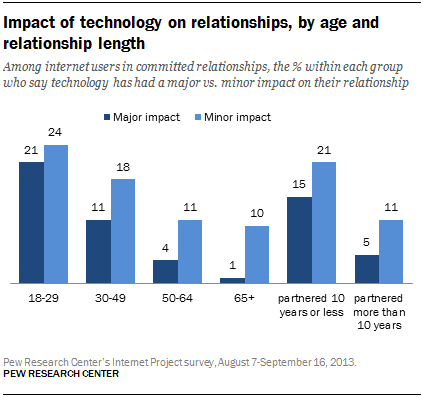
Social media has a larger affect on younger and newer relationships than it does on older and more aged relationships. In a graph from pewresearch.com, it’s main claim states, “Social media had less affect on people’s relationships as the get older and as their relationships go on.” This claim is supported by that data taken in 2013. The graph shows that from ages 18 to 29, 21% of relationships are majorly affected by social media. From ages 50 to 60, however, only about 4% of relationships become majorly affected by social media’s influences. Also, 15% of partners for ten years or less are affected majorly by social media, while only 5% of partners for ten years or more are majorly affected by social media. This goes to prove the point that newer generations and newer couples are more affected by social media and this could be the cause of more relationships not working out or not being as deeply connected as those of couples who have been together longer or people of an older age.
The frequent amount of relationships made on social media daily can certainly be seen as be beneficial, however, social media does have a heavy impact on them especially seen in younger ages. Social media is able to connect people of long distances in order to maintain long distance relationships, but it also may create relationships that aren’t as authentic or make real life relationships weak.
Haley Fowler is a tenth grade student in Kentucky. She is a proficient and avid user of social media and many ideas and events in her life are influenced positively and negatively by social media.
The smell of fresh cut grass and chlorine burned my nose as I stepped outside and onto the pool deck. “Mimi, let’s go swim!” It was the first day of summer break. I had just gotten out of my fourth grade year of school, and I was beyond excited to be at the pool all summer with my little sister, Mollie. We had been swimming with our Mimi every summer since we could remember.
The sun was hitting our backs as Mimi applied sunscreen to our skin. The pool deck felt like hot coals against our feet. “Last one in is a rotten egg” is what I shouted to Mollie as I waited for Mimi to finish putting on my sunscreen. We were being competitive… what’s new? The moment I felt my Mimi’s hands leave my back, raced to the pool, determined to beat my sister and be the first one in the water. I hit the water and as soon as my head went under, water rushed up my nose and my mouth.
Panic filled my mind and water rushed over me. It ran through my nose and in my eyes. I looked up just enough to see the fear in my Mimi’s face. As I was still flailing like a fish in the water, I watched glimpses of my Mimi as she dove into the water, still fully clothed. I felt the embrace of her strong arms wrap around me and pull me above the water. A sense of relief washed over me as I looked into her eyes. Then, all of a sudden, I watched her eyes that were once filled with fear and panic fade into dismay and then laughter.
Through tears, I was able to mutter out, “Why are you laughing, Mimi?” Then, out of nowhere, she dropped me back into the water. That sense of fear rushed over me once again. I rolled out of her arms and plopped my feet to the bottom of the pool. I then knew why she and now my sister were laughing so hard at me. My feet could touch the bottom.
Now, out of embarrassment, I began to cry even more. They laughed even harder. Now my face was wet from tears and not just the pool water. My little sister jumped in and started mocking me. I splashed her and she splashed me back. We began a huge war shoving water in each others faces, and soon enough, our Mimi was part of the fight as well. She still had on all of her clothes, but she didn’t mind because she was with her grand daughters making memories.
I had been taught how to swim by my Mimi at three or four years old, so the craziest part it of it all is that I’m now a competitive swimmer. After every meet I’m mockingly asked by a family member “Could you touch the bottom?” or “Who had to jump in and save you this time?”
“You educate a man; you educate a man. You educate a woman; you educate a generation.” -Brigham Young
To me, this quote by Brigham Young means that if a man is educated, he will keep his knowledge and is likely to not pass it on, but if a woman is educated, she will take her knowledge and pass it to her children, men, and other women around her. Women have a nature that is very giving and nurturing which leads them to be able give and pass what they know to others.
Also, a women is able to reproduce; because of this, she is able to educate and give back to entire generation by having children. These children share the mother’s knowledge and thus, a generation can be educated.
This quote relates to the novel because the men have banned all women from reading and writing and one of the reasons why is for power. When women or anyone is able to read and write they have power, and that was taken away from women in “The Handmaid’s Tale” by Margret Atwood.
In the poem, “Same Song”, Pat Mora uses a reflective tone to show how the mother reflects on her children’s views of themselves. It can be seen that the mother is reflecting on her children and how much they care about their appearance when she sees her daughter “stumble into the bathroom at six a. m.” to begin getting ready, and when shes sees her son “jog a mile in the cold dark.” This shows the tone of reflection because the mother reflects on how early her daughter wakes and how her son stays up later to try to improve the way they look. They’re trying to achieve a look like everyone else. A reflective tone is also shown when the daughter and son peer into the “mirror, mirror on the wall” and “frown” in the disappointment they have towards themselves. They reflect on how hard they try to make themselves look how they want by “stroking Aztec blue eye shadow on her eyelids” and “lifting weights in the garage,” but it still isn’t enough for either of them. After making themselves uncomfortable by “squeezing into faded jeans” and “one-handed push-ups and one hundred sit-ups,” the two teenagers still look into the mirror and frown as they reflect on what’s “not fair.”
Power is a strong charactristic. It can determine the amount of importance one has, and it can determine whether or not a person has a voice among others, along with many other things. In today’s society, power differs between people based off their race, the religion they follow, their gender, etc. It is the same way in The Handmaid’s Tale; the amount of power a person in the novel has differs based on their age, their gender, the amount of money they have, and their fertility. In the novel, The Handmaid’s Tale, Margret Atwood displays the theme of power numerous times throughout the book that also connects with today’s real world in several different ways.

In The Handmaid’s Tale, Atwood displays the theme of power on page 182. It says, “But something had shifted, some balance. I felt shrunken, so that when he put his arms around me, gathering me up, I was as small as a doll.” This clearly shows the theme of power because Offred is describing how she felt in Luke’s arms after her power was taken away. Although the only power that was taken from her along with all other women was her ability to make and spend her own money, she still felt as if Luke had more power over her because he could do something more that she couldn’t. The truth is, Luke and every other man did gain more power over her because of this. Also on page 182 it says, “We are not each other’s anymore. Instead, I am his.” This piece of text greatly exhibits the theme of power because it shows that Offred has no power anymore, for it has been diminished by the fact that she lost her job and her money was cut off. Now, instead of having power and being able to be an independent woman, she is forced to rely on Luke. This easily makes her feel as if she is his because she now cannot do much anything with out his help. This connects to the real world because it relates to the fact that often times, the power that women hold in today’s world is overtaken by the power that most men have. In an article from politico.com, Keisha N. Blain answers, “Regardless of a women’s experience, education or abilities, the patriarchal nature of U.S. society fosters the oerception that women are less qualified and less competent than men. What patriarchy has done is convince people that a strong and intelligent woman represents a problem.” This quote explains that a strong woman is a bad thing, which is how the men in The Handmaid’s Tale saw women even before the dystopia, Gilead, was created. Because of this, the independent and strong women’s power is lessened by the more power men have.
Another instance where Atwood shows the theme of power in her novel is on page 210 when she wrote. A quote on page 210 displays the theme of power is “Right now I’m not afraid of him. It’s hard to be afraid of a man who is sitting watching you put on hand lotion. This lack of fear is dangerous.” This theme also shows how Offred is gaining power over the Commander. It is easy to see that in this piece of text because Offred is losing her fear of the Commander which, in turn, gives her power. On page 186 it says, “The pen between my fingers is sensuous, alive almost. I can feel its power, the power of the words it contains.” This quote shows the power Offred feels just by doing something as simple as writing. Since Gilead was created, she hadn’t been allowed to read or write, so the fact that she was able to do this when all other women couldn’t, makes her feel power over those women and the Commander because she was able to write in his presence. These pieces of text relate to the real world because they model how people with little power can use people of high power to gain theirs. When talking about power in an article from wordpress.com, an author writes, “Influential Power- Is when the person does not have power and they are trying to gain influence over you.” It also says, “Instrumental Power- When the person already has power over usually due to authority or law.” These types of power are both seen by the relationship between Offred and the Commander. Influential power is used by Offred because she used the advantage of their “meetings” to get things such as hand lotion and the ability to read and write while playing their Scrabble games. The Commander uses the instrumental power he has over Offred and most other people because he is one of the creators of Gilead which makes him very high up in authority.

One more example of the theme of power in The Handmaid’s Tale is on page 210 when it says, “It’s difficult for me to believe I have power over him, of any sort, but I do; although it’s of an equivocal kind.” This quote shows that even though it’s a minute amount, Offred has gained power over the Commander. She recognizes that it’s not the same amount that he has over her, but she notices that she has the power, which is important to her. Throughout the novel during their meetings, Offred uses this small amount of power to take tiny advantages over the Commander. On forbes.com, Janet Napolitano states, “I think power is the ability to affect change and to not necessarily control but to manage issues and mange people to achieve a larger vision.” This relates to the quote from The Handmaid’s Tale because Offred uses the power she gains over the Commander to take the advantages over him throughout the novel. She affects change in her life by using her power that not many other women have to get some of the things she wants that the Commander can get for her.

In The Handmaid’s Tale, Margret Atwood incorporates the theme of power numerous times. She uses this theme so she can show how the importance of the people in Gilead differ based on the amount of power they hold. To Offred, power comes to her in different ways that can be clearly seen by the reader throughout the novel. In this novel, Atwood displays the theme of power throughout her book, which also connects to today’s real world.
“Is it better for a man to have chosen evil than to have good imposed upon him?” – Anthony Burgess
To me, this quote is asking if it is better for a man to be forced to be good than it is for him to choose to be evil. In my opinion, it would be better for a man to choose evil rather than be forced to be good. This is because if the man is forced to be good, he is being masked by something that he truly is not; however, if the man chooses to be evil, then others are able to see who he really is.
If a man is forced to be good but is still evil at heart, then he is no better than a man who chose to be evil in the first place. If he pretends to be good while still evil, then he is still dangerous in a way because he is not sincere to the people around him. On the other hand, if a man who is forced to be good ends up changing and being genuinely good, then in this situation, it would be better that he was forced to be good in the first place.
This quote relates to The Handmaid’s Tale because most of the men in the novel pretend to be good, even if they are not so that they do not have to participate in the Men’s Salvagings. They force themselves to be good even if they are not as a way of survival. In my opinion, the men forcing themselves to be good in the novel is acceptable so that they can stay alive and aren’t killed only because they are evil and go against scripture.
After reading Of Mice and Men, construct an essay analyzing the common theme Steinback represents with hands.
In any novel, many themes can be concluded by any reader; these themes are reoccurring most of the time and they help develop the story. Of Mice and Men contains several different themes that originate from motifs throughout it, and these themes can be interpreted several different ways based on the context of the book. In the novel Of Mice and Men, Steinback incorporates a common motif of hands that gives numerous themes such as innocence, violence, and betrayal that relate to events throughout the novel.
One of the themes that Steinback incorporates throughout the novel is innocence, which is mainly displayed by the character Lennie. On page 5, Steinback integrates the theme of innocence when he says, “Lennie held his closed hand away from George’s direction. ‘It’s only a mouse, George.'” This quote includes the theme of innocence because it shows that Lennie doesn’t want to give up the mouse he sees kind of like a new pet that he had been carrying in his hand because “it’s only a mouse.” Another way the Steinback shows the theme of innocence in his novel is on page 9. The story says, “He heard Lennie’s whimpering cry and wheeled about. ‘Blubberin’ like a baby! A big guy like you.’ Lennie’s lip quivered and tears started in his eyes. ‘Aw, Lennie!’ George put his hand on Lennie’s shoulder. ‘I ain’t takin’ it away jus’ for meanness. That mouse ain’t fresh, Lennie; and besides, you broke it pettin’ it. You get another mouse that’s fresh and I’ll let you keep it a little while.'” This further conveys the innocence that Lennie displays by showing how upset Lennie became when George had to take his mouse away. Even though he had accidentally killed it, Lennie didn’t realize he needed to give up the mouse to George so he could get rid of it. Another instance where the theme of innocence is presented is on page 87. It says, “‘He was so little,’ said Lennie. ‘I was jus’ playing with him… an’ he made like he’s gonna bite me… an’ I made like i was gonna smack him… an’… an’ I done it. An’ then he was dead.'” Steinback’s reference to Lennie’s hands killing the puppy shows his innocence because it shows how careful Lennie was trying to be while playing with the puppies, yet he still wasn’t able to control his strength. It was easy to see how upset Lennie got when he accidentally killed the puppy, which clearly shows his innocence.

Some may think the actions Lennie has done relates to violence rather than innocence, which may also be true, seeing as Steinback uses “hands” to represent several different themes throughout the book. On page 63 it says, “Curley’s fist was swinging when Lennie reached for it. The next minute Curley was flopping like a fish on a line, and his closed fist was lost in Lennie’s big hand.” This evidence seems to suggest the theme of violence coming from hands because it shows that the men were fighting and Lennie’s large hands were able to help him win the fight. Another way the theme of violence is presented is on page 91 when it says, “She jerked her head sideways, and Lennie’s fingers closed on her hair and hung on. ‘Let go,’ she cried. ‘You let go!’ Lennie was in a panic. His face was contorted. She screamed then, and Lennie’s other hand closed over her mouth and nose.” It is elucidative to see that this evidence supports the theme of violence because it shows how even though Lennie couldn’t control his own strength, he still ended up with an act of violence that resulted in him killing Curley’s wife.

Although most of the themes based on the motif hands have been conveyed through Lennie, one of the themes that has not been presented by him was betrayal. This theme was displayed by George. On page 106 it says, “And George raised the gun and steadied it, and he brought the muzzle of it close to the back of Lennie’s head. The hand shook violently , but his face set and his hand steadied. He pulled the trigger.” This quote shows overwhelming evidence to support the theme of betrayal; Lennie and George were supposed to stick together until the end–or until they got to their Dream Farm–but instead, George betrayed Lennie. The motif of hands is present in this piece of evidence because it shows how George’s hands pulled the trigger of the gun, which killed his best friend, Lennie.

The motif of hands is heavily reiterated throughout Of Mice and Men. Steinback incorporates this motif in his novel, along with many others, in order to develop several different themes to draw any reader in deeper to his story. The themes that are frequently integrated throughout Of Mice and Men that originate from the motif hands are innocence, violence, and betrayal.
As youth, it is not hard for us to be influenced or manipulated to accommodate social norms. Youth culture as a whole is easily influenced by how we see other people act, look, or live their life. Social media has made it much easier for the youth culture to change to fit these common looks and personalities. It is elucidative to see that many teens basically live their life comparing themselves to influencers or even their friends that the see on social media. According to an article from Time.com, “Other research has found that the more social networks a young adult uses, the more likely he or she is to report depression and anxiety trying to navigate between different norms and friend networks on various platforms could be to blame…” Social media as a whole affects youth culture in several different ways, both positive and negative.

One of the main forms of social media used by almost every teen is Instagram. Instagram is an app where people are able to share photos of themselves with a caption with their followers to get as many likes and comments as they can. This app is one of the most common ways youth culture is influenced. It is easy to find accounts with many followers that have edited and changed their posts so much that it creates an unrealistic image that youth long to be like. When asked how she thinks social media affects the youth culture, peer, Eliza Cook said, “Instagram has many different influencers, especially for teens, making them want to dress or look a certain way. I also believe that people only post the good trying to make themselves look the best and hide the bad. It’s almost like a competition for who lives the best lives.” New styles and trends are brought to Instagram by popular influencers all the time and popularity changes frequently.
New styles and trends are brought to Instagram by idolized influencers all the time and their popularity changes quickly. Click here to see how rapidly influencers gain and lose popularity by the Instagram community. By looking at Instagram, users are able to see that Emma Chamberlain is one of the popular influencers. It is seen that she frequently changes the way she posts (captions, filters, etc.) to match the trends that are asthetically pleasing for most followers. When popular users change their style of posting, other, less popular users will change to match their content. I know, just by looking at the feed many of my peers post, that we are all guilty of conforming to all of the changes and trends seen on Instagram and other social media apps daily.

Not only Instagram, but also Snapchat heavily influences youth culture. Snapchat is a social media app that almost all teens have downloaded. Users are able to send pictures or chats directly to their friends and they disappear immediatly. They can also post a picture for twenty-four hours to their story for all of their Snapchat friends to see. Many adults have this app as well, but it is most frequently used by teens. Adults (mainly parents) are not big advocates of this app, seeing as many younger users are able to hide things using the app. Much like Instagram, Snapchat also has many negative impacts on mental health. “Negative mental impacts from Snapchat include things like anxiety, loneliness, and depression. Looking at carefully filtered pictures of other teens and tweens can also lead to body consciousness and eating disorders, fear of missing out, and bullying…” says an article from Knect365.com.
YouTube is one of the last forms of social media that is often used by youth. Theverge.com said “85 percent of teenagers (ages 13-17) say they use the platform. Closely behind are Instagram (72 percent) and Snapchat (69 percent).” On YouTube, people are able to post videos for their followers and then the followers are able to give likes, dislikes, and comments on the videos. YouTube is the least harmful form of social media when it comes to mental health. When videos are posted, there are some users that tend to comment hate on the videos, however, people are able to see a more real image of the people who have posted the videos. According to Forbes.com, “40 percent of millineal YouTube subcribers say that their favorite content creators understand them better then their friends and 70 percent of teens admit that they can relate to those folks more than to traditional celebrities.” This shows that YouTube creates a safe and “warm” type of environment for users of all ages. Since people feel more comfortable on YouTube, subscribers are able to open up more about themselves through videos, comments, etc. This results in less negative mental health for users and a more positive environment where almost everyone can share their thoughts and get things off their chest, even if it’s to popular YouTubers that will most likely never meet or communicate with.

Social media is influencial to almost every teenager right now. It is easy to notice how much it all plays a part in the everyday lives of youth. I can tell that it even influences myself. I too am guilty of comforming to some of the norms presented by the many forms of social media. Whether it be good or bad, people are persuaded by many different popular influencers everyday. Social media affects youth culture in more ways than on, positively and negatively.
 And That's the Tea, Sis